

Pan-Turkism is the illegitimate child of the Jews!
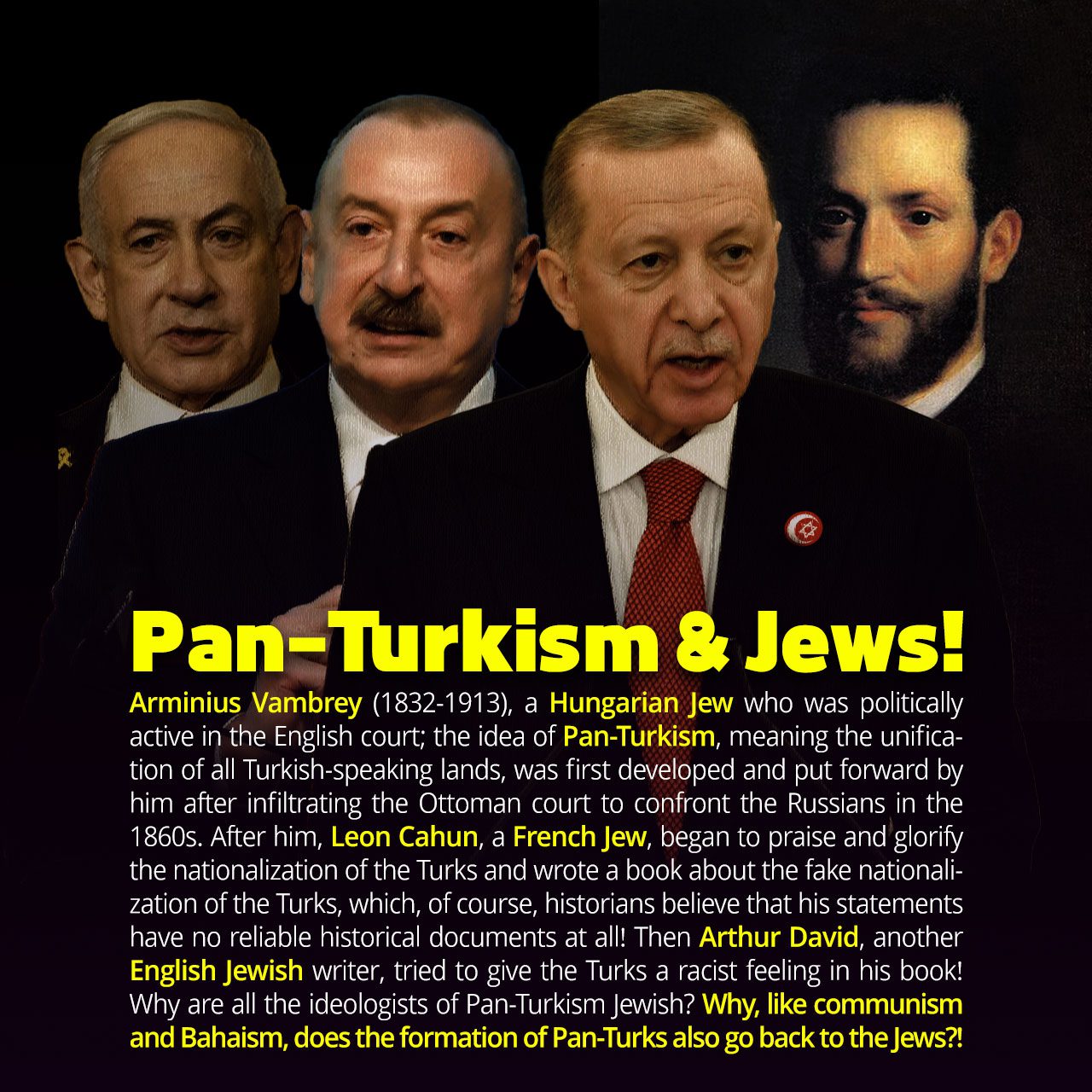
Arminius Vambéry, a Hungarian Jew who engaged in political activities at the British court, gradually infiltrated the Ottoman court and instilled the earliest ideas of Pan-Turkism there, intending to create a barrier against Tsarist Russia.
After him, Léon Cahun, a French Jew, began glorifying and promoting the nationalization of Turks, writing a book about the fabricated nationalization of Turks. However, historians believe his claims lack any credible historical evidence! Then, Arthur David, another English Jewish writer, attempted to instill a racist sentiment among Turkic-speaking peoples in his book!
But a question arises: Why were all the early ideologists and authors of Pan-Turkism books Jewish? Why, like Communism and the Baha’i Faith, does the foundation of Pan-Turkism also trace back to Jews?!
Biography:
Arminius Vambéry (1832–1913) was a Hungarian Jewish linguist and traveler. He had a remarkable talent for learning languages, mastering several European and Asian languages by the age of twenty. Among his most notable activities were his travels to Central Asia and documenting his observations and findings.
Shortly after his birth, he lost his father, spending his childhood in poverty. However, due to his exceptional intelligence and talent, he managed to succeed through perseverance.
Driven by an insatiable passion for linguistics, he immersed himself in the field, demonstrating his abilities by mastering several living world languages. Through diligent effort, he studied various European and Asian languages, traced the roots of their vocabulary, and became well aware of the profound mutual influence of Eastern and Western literatures.
Due to his dedication, by the age of twenty, he had mastered several major European languages to a level suitable for teaching at universities and reputable academic institutions. However, his love for travel—driven by a desire to find commonalities between his mother tongue and Tatar-Turkic dialects, as well as to explore other lands—changed his destiny. He first spent several years in Constantinople, living among Turkish families and learning their way of life. In a short time, he assimilated so well into their social and behavioral norms that he hardly stood out. This talent for adopting the behavior and speech of a true Turk, or more precisely, an efendi, became the key to his survival in lands that were uncharted and perilous for travelers and researchers like him.
Vambéry later decided to travel to Central Asia. To this end, he traveled from Istanbul to Khoy, Tabriz, Zanjan, Qazvin, and Tehran. After a long stay, he traveled in disguise as a dervish to Qom, Kashan, Isfahan, and Shiraz. Then, after touring Mazandaran and the southern shores of the Caspian Sea, Mashhad, and Herat, he proceeded to Central Asia. At the end of his journey in 1864, he documented his observations and findings from his stay in Central Asia, which were well-received by Orientalists and historical researchers.
Vambéry passed away in Budapest on September 15, 1913, at the age of 81, a year before World War I, after a lifetime of research and teaching.
The idea of Pan-Turkism—unifying all regions where the inhabitants speak languages rooted in the Altaic language family—was first constructed and promoted by Arminius Vambéry in the 1860s. Vambéry had become an advisor to the Ottoman Sultan but secretly worked for Lord Palmerston and the British Foreign Office. The creation and promotion of this idea by Vambéry and Britain aimed to establish a belt of Altaic-speaking peoples in southern Russia to hinder Russian expansion and infiltration into British colonies in India. Later, other writers continued Vambéry’s work, including the French writer Léon Cahun, who, in his book Introduction to the History of Asia, shaped and propagated Pan-Turkism. Arthur Lumley David, another Orientalist, through his writings on the glory of ancient Turkic history and the characteristics of the Turkish language, cultivated the idea of a great Turkic nation in the minds of Ottoman intellectuals and provided the necessary materials for the formation of Pan-Turkist ideology.
Arminius Vambrey (1832-1913), a Hungarian Jew who was politically active in the English court; the idea of Pan-Turkism, meaning the unification of all Turkish-speaking lands, was first developed and put forward by him after infiltrating the Ottoman court to confront the Russians in the 1860s. After him, Leon Cahun, a French Jew, began to praise and glorify the nationalization of the Turks and wrote a book about the fake nationalization of the Turks, which, of course, historians believe that his statements have no reliable historical documents at all! Then Arthur David, another English Jewish writer, tried to give the Turks a racist feeling in his book! Why are all the ideologists of Pan-Turkism Jewish? Why, like communism and Bahaism, does the formation of Pan-Turks also go back to the Jews?!
