

The Big Lie of Maps! / The World Map Is a Huge Mistake!
The Big Lie of Maps! / The World Map Is a Huge Mistake!
You’ve probably looked at political world maps countless times — in geography textbooks at school, on Google Maps, on a wall map at home, and many other places.
But have you ever paid close attention to the sizes of countries?
Size matters!
Whenever you pick up a map, you might find yourself thinking: Wow, look how huge Russia is! Or perhaps Greenland’s size grabs your attention. Whatever seems more striking to you, the truth is that you’ve most likely been deceived. Don’t believe it? Then open your eyes.
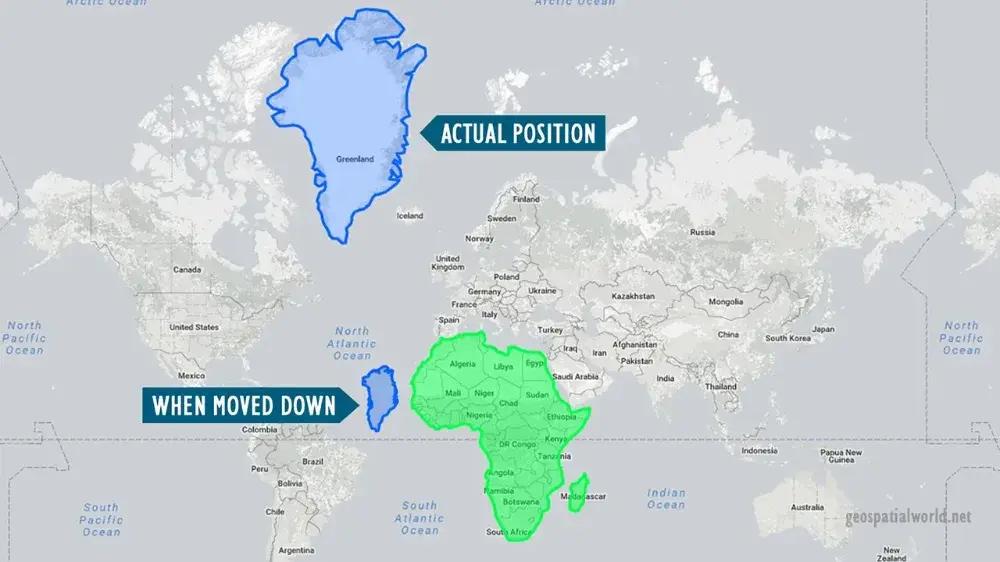
Comparing Greenland with Africa
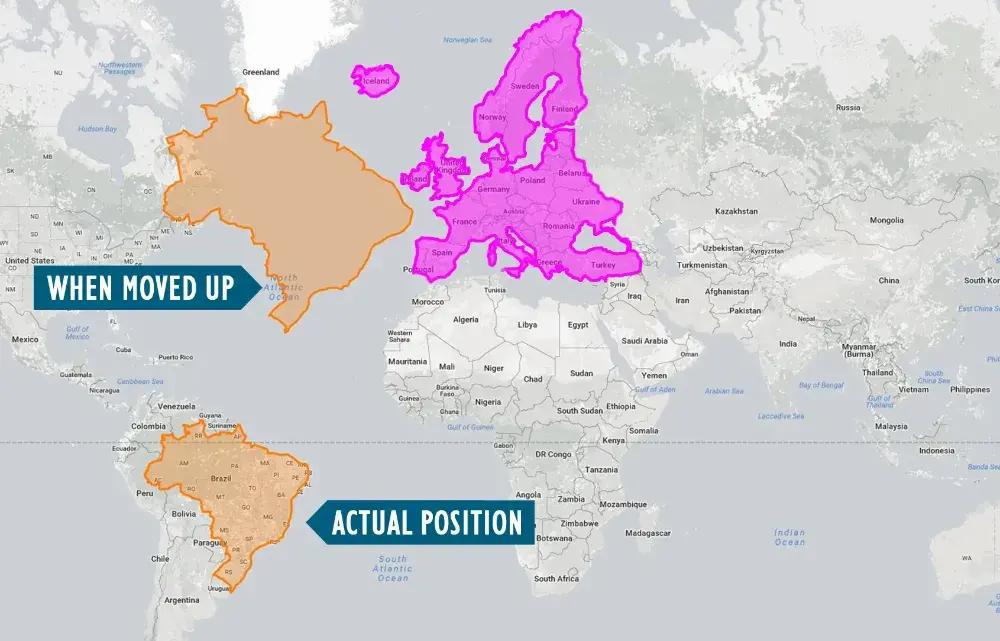
Comparing Brazil with Europe
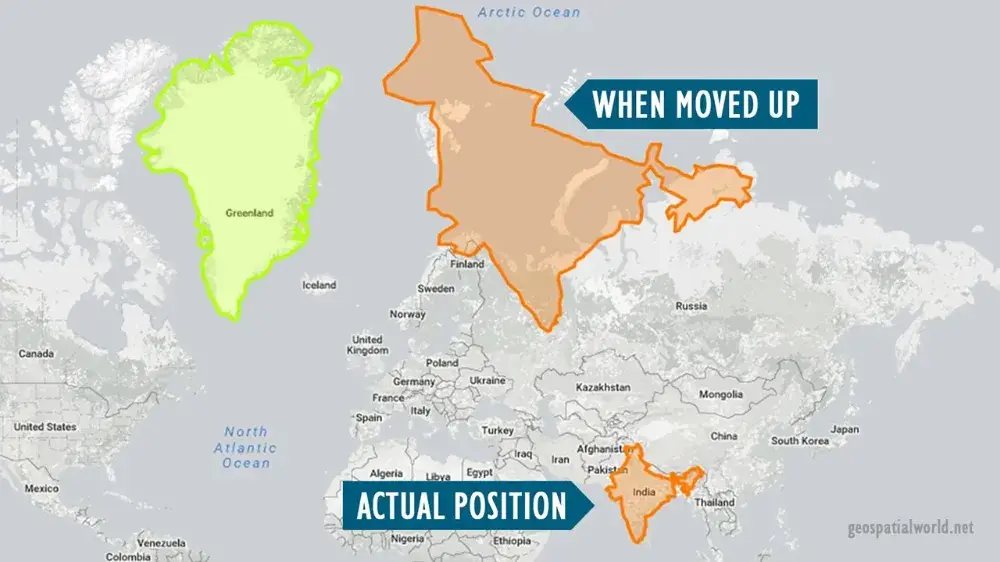
Comparing India with Greenland
But why is it like this?
It’s simple: everything is made for a specific purpose. You shouldn’t expect a two‑dimensional map to accurately represent a three‑dimensional world. The whole idea behind this kind of map was for navigation, designed by a man named Gerardus Mercator. He didn’t care whether the countries’ sizes were accurate or not!
Is there another reason?
“Yes — those racist, colonialist Europeans wanted their own countries to appear larger and superior to Africa and Asia.”
The actual land areas of some countries:
- Russia: 17,098,000 km²
- China: 9,598,000 km²
- United States: 9,629,000 km²
- Brazil: 8,515,000 km²
- Australia: 7,618,000 km²
- Europe excluding Russia: 6,237,000 km²
- India: 3,402,000 km²
- Saudi Arabia: 2,149,000 km²
- Iran: 1,873,000 km²
- Turkey: 783,000 km²
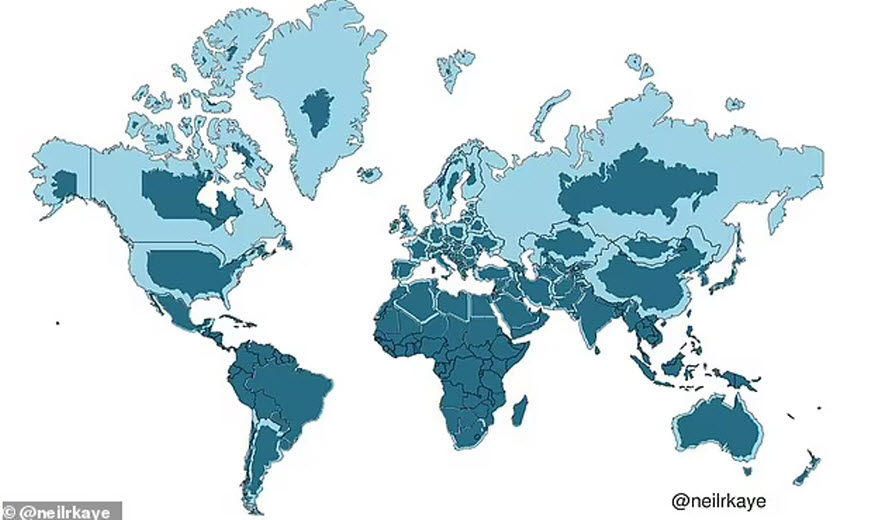
Below is the actual size of countries on a corrected world map:
When you look at a standard world map, it’s easy to assume that Greenland and Africa are similar in size. But in reality, Africa is 14 times larger than that icy northern landmass.
Greenland’s total area — including some offshore islands — is 2.16 million km², while Africa is 30.4 million km².
And that’s not all. Africa is three times larger than North America and significantly larger than Russia. But you would never guess that by looking at common maps.
Many countries — including Russia, Canada, and Greenland — aren’t anywhere near as big as people think. This is due to something called world map distortion.
This phenomenon comes from the Mercator projection — the map commonly hung on classroom walls and printed in textbooks. It was created in 1596 to help sailors navigate the world.
The Mercator map preserves shapes well, but at the cost of severely distorting sizes, favoring the wealthy northern lands.
For example, Canada and Russia appear to take up almost 25% of Earth’s surface on a world map, when in reality they cover only about 5%.
Australia also seems similar in size to Alaska, but it is actually the sixth‑largest country in the world — and 4.5 times bigger than Alaska.
The biggest challenge in creating a world map is that it’s impossible to project a spherical Earth perfectly onto a flat surface — a problem that has troubled cartographers for centuries.
As a result, world maps have taken many shapes — hearts, cones, and more.
But eventually, one model — the Mercator projection — outcompeted the rest.
Its distortions were studied by Neil Kaye, a data scientist at the UK Met Office, who created a two‑dimensional layout showing what the world really looks like. He used Met Office data on the size of each country in Ggplot, a statistical visualization package.
Then he generated the final map using a stereographic projection tool — a function that projects a sphere onto a flat plane.
Now, if you go to www.thetruesize.com, search for Iran, and drag it over Greenland, the map will adjust according to latitude. You’ll see that Iran is only slightly smaller than Greenland — not several times smaller as traditional maps suggest.
So now tell me — have you also been fooled all this time, or not?
